Strategic Thinking:
Reusable Food Packaging in the Circular Economy
The Master’s thesis was completed in 2025 as part of my MSc in Environment and Resource Management at Vrije Universiteit Amsterdam. It addresses the global plastic waste crisis by examining the significant “intention–action gap,” where consumers express a desire to act sustainably but often fail to follow through. It investigates the motivations and barriers to adopting Reusable Food Packaging Systems (RPSs) through a comparative study of Dutch and Asian cultural groups in the Netherlands. The goal is to uncover the underlying reasons behind these behavioural gaps and to develop data-backed recommendations for stakeholders and policymakers to encourage more effective adoption of sustainable packaging practices.
Key Skills Applied:
Circular Economy Framework · The R-ladder · Quantitative and Qualitative Research · Stakeholder Interviews · Stata (OLS Regression Modelling, t-tests) · Atlas.ti (Stakeholder Mapping & Analysis) · Academic Writing
Master’s Thesis Overview:
The "Intention-Action" Challenge
Analytical Framework & Methodology
Frameworks Used:
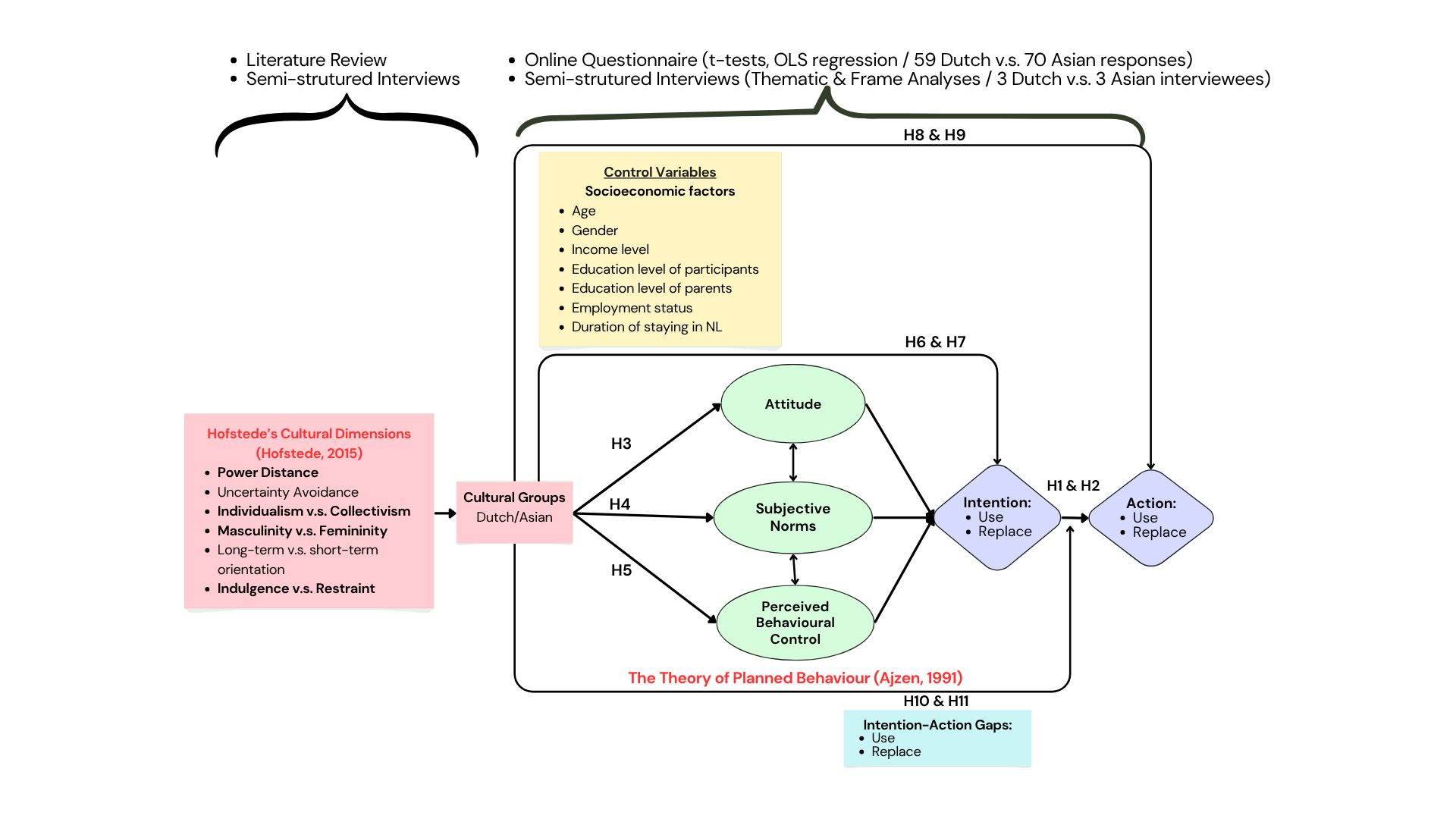
Applied the Theory of Planned Behaviour (TPB) to model psychological drivers (Attitudes, Subjective Norms, PBC) and Hofstede’s Cultural Dimensions to assess cultural influences.
Data Collection:
Executed a mixed-methods approach involving an online survey (n=129) and semi-structured interviews (n=6).
Data Analysis:
Performed Multiple OLS Linear Regression, Independent Sample t-tests, and Paired-sample t-tests using Stata; conducted thematic and frame analysis using ATLAS.ti.
The findings revealed that cultural background did not significantly influence sustainable intentions or behaviours, as regression models showed no notable difference between Dutch and Asian groups.
• Statistical Findings: While the intention to use returnable packaging was high, a statistically significant gap was found in replacing disposable options with reusable ones (p<.001). Higher-income individuals reported lower Perceived Behavioural Control and lower intention to replace disposables, likely due to a higher prioritisation of convenience over sustainability.
• Qualitative Barriers: Interview data revealed that the primary obstacles were systemic: a lack of knowledge regarding returning procedures and the limited availability/facilities for returnable options in the Netherlands. Both groups noted that the "logistics process" and "confusion regarding procedures" were major deterrents to consistent action.
Key Data Insights: Beyond National Culture
Strategic Recommendations & Business Impact
To effectively enhance the adoption of Reusable Food Packaging Systems, several strategic interventions are recommended.
First, infrastructure improvements are essential — retailers should increase convenience for high-income groups by situating return points in easily accessible locations such as office buildings and residential complexes.
Second, education campaigns should address the existing knowledge gap by offering concise, clear instructions on RPS usage and return processes, particularly targeting individuals with lower sustainability awareness.
Finally, a strong value proposition is crucial: emphasising the long-term environmental and financial benefits, along with economic incentives such as deposit systems, can help motivate career-driven and goal-oriented consumers to engage more consistently in sustainable behaviour.